
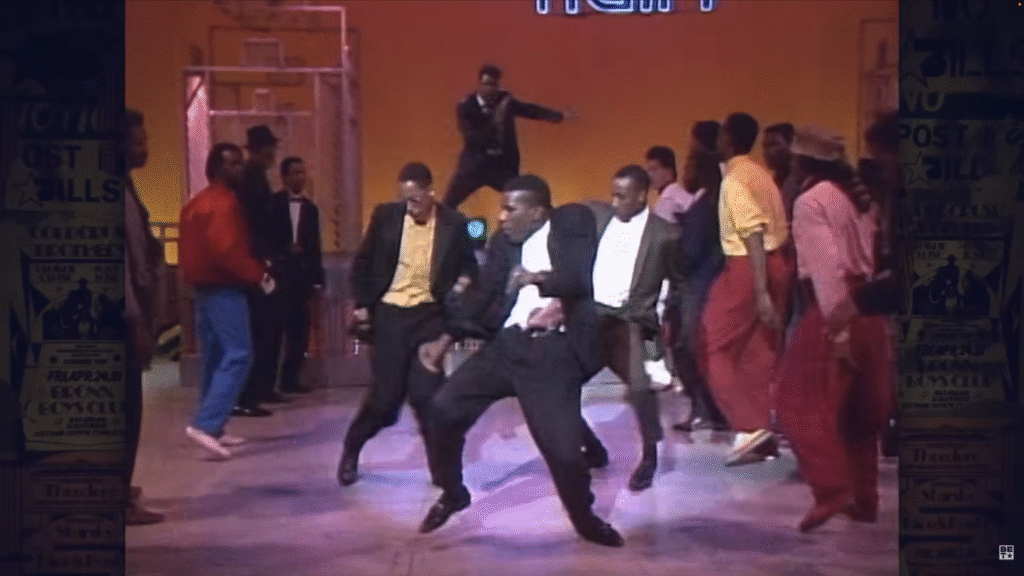
BET Shines a Spotlight on the Soul Brothers, the Legendary Los Angeles Dance Crew That Helped Define Hip-Hop’s Golden Era
LOS ANGELES — August 13, 2026 — Long before hip-hop dance became a global industry, before choreography traveled instantly across social media, and before dancers routinely became stars in their own right, a group of young Los Angeles dancers known as the Soul Brothers were helping create the visual language of hip-hop.
In a special feature tracing the story of the legendary Los Angeles dance crew, V-LUV looks back on the Soul Brothers’ journey from Southern California’s underground dance scene to television, music videos, major concert stages and some extraordinary encounters with cultural icons.
Today, BET turned the spotlight back on that history.
The feature captures something bigger than nostalgia. It documents a generation of dancers who weren’t simply performing behind hip-hop artists—they were helping define the culture as it was being created.
“We were the show,” V-LUV recalls in the BET feature.
From Los Angeles Dance Floors to Hip-Hop’s Golden Era
The roots of the Soul Brothers stretch deep into Los Angeles.
V-LUV recalls beginning with the influences familiar to countless young dancers of his generation: the Jackson 5, What’s Happening!!, Soul Train, popping and locking, and eventually breaking. As a kid, he even performed under the name Dr. Popper, complete with a golf hat and white gloves.
The Soul Brothers name itself came from James Brown and his famous “Soul Brother No. 1” identity.
But the group quickly developed an identity of its own.
Drawing members from several Los Angeles-area high schools, the Soul Brothers emerged from a thriving Southern California dance culture where crews gathered, competed, exchanged ideas and developed styles in real time.
Their early soundtrack included the fast electronic rhythms of artists and groups such as Egyptian Lover, Cybotron and the World Class Wreckin’ Cru. Dancing to music pushed to around 130 beats per minute helped develop the endurance and precision that would later become a weapon when the crew entered hip-hop’s Golden Era.
By 1988, everything was changing.
Hip-hop had entered what V-LUV describes as a moment when the rapper, DJ and dancer existed together as essential elements of the same culture.
Originality was everything.
“You couldn’t sound like anybody else. You couldn’t dance like anybody else,” he remembers. “Everything had to be pure and raw.”
The Soul Brothers fit perfectly into that world.
Soul Train — and Refusing to Conform
The crew’s individuality didn’t always fit comfortably within the entertainment establishment.
V-LUV remembers appearing on Soul Train before the group’s evolving appearance began pushing against expectations. The Soul Brothers started showing up in overalls, twisting their hair and embracing a look that reflected who they were becoming.
According to V-LUV, Soul Train host Don Cornelius once remarked that the group looked like “runaway slaves.”
Eventually, they were removed from the show.
For V-LUV, however, the experience became another example of something that would define the Soul Brothers throughout their career: they were determined to be themselves.
Def Jef and the Moment Everything Changed
A pivotal chapter arrived when the Soul Brothers connected with Los Angeles rapper Def Jef.
After meeting Jef at World on Wheels, the legendary Los Angeles skating rink, members of the crew eventually began rehearsing and performing with him.
The chemistry was immediate.
Following a performance for Delicious Vinyl, the relationship was cemented, and the Soul Brothers became an important visual component of Def Jef’s performances and videos.
Unlike the traditional model of anonymous background dancers, Def Jef gave the crew room to establish their own identities. Their names were called during shows. They received their own moments onstage. His videos devoted real screen time to the dancers rather than treating them simply as scenery behind the artist.
“Dancing with Def Jef, we became our own voice,” V-LUV says.
That freedom helped produce work that remains embedded in Golden Era hip-hop imagery—including “Droppin’ Rhymes on Drums,” which V-LUV describes as a hip-hop dance classic.
His contribution went beyond dancing.
V-LUV says Def Jef asked him to write a treatment because of his ability to tell stories. Having already experimented at home by editing dance footage between VCRs and a tape deck, he became involved in the editing process as well—an experience that opened another creative door.
From Young MC to Everlast: The Soul Brothers Were Everywhere
Once the Soul Brothers broke through, their résumé expanded rapidly.
V-LUV remembers working on videos connected with Young MC, Everlast, MC Trouble, Pebbles, Salt-N-Pepa, Whodini, Brownstone, Naughty by Nature and others.
They moved through multiple eras of hip-hop dance—from breaking and popping into what they called “hip-hop boogie,” freestyle movement and the choreography associated with Golden Era rap.
They were also present as hip-hop itself began changing.
As the Golden Era gave way to West Coast G-funk, the role of the hip-hop dance crew began changing with it. Artists such as Snoop Dogg and MC Eiht represented a different visual language—one that no longer required the elaborate dance crews that had become such a recognizable part of the previous era.
It was, as V-LUV describes it, “a change of the guards.”
The Michael Jackson Moment That Almost Changed Everything
One of the most remarkable stories in the BET feature involves Michael Jackson’s “Remember the Time.”
By then, the Soul Brothers had built enough of a reputation that V-LUV says auditions were increasingly unnecessary. When dancers gathered for the Michael Jackson project, director John Singleton recognized the crew.
According to V-LUV, Singleton saw them and immediately said they were exactly what he had been looking for.
The plan was extraordinary.
V-LUV says Singleton envisioned a sequence featuring Michael Jackson and V-LUV dancing together, culminating in the famous moment when Jackson spins and disappears into dust.
But it never happened.
V-LUV recalls that the crew’s call time had apparently been altered on their paperwork. By the time the situation was discovered, production was running out of time and the planned sequence was eliminated.
For the Soul Brothers, it represented far more than a missed cameo.
A prominent Michael Jackson credit could have opened an international touring market—Germany, France and beyond—and potentially elevated the dancers into an entirely different economic tier.
Instead, the moment disappeared.
Soon afterward, V-LUV began stepping away from the business, turning his attention toward fatherhood, culture and life beyond the industry.
Dancing for Nelson Mandela
Yet one of the Soul Brothers’ greatest achievements had nothing to do with record sales or music videos.
The crew performed at the Los Angeles Memorial Coliseum during Nelson Mandela’s historic visit following his release after 27 years in prison.
For V-LUV, it remains one of the defining experiences of the Soul Brothers’ history.
The crew had the opportunity to see and meet Mandela and participate in a moment that transcended entertainment.
The following day brought another extraordinary encounter: an event involving Quincy Jones and Dionne Warwick, attended by major political figures.
V-LUV also recalls the Soul Brothers performing at events connected with Jesse Jackson and Louis Farrakhan, as well as being among the early dancers appearing on Yo! MTV Raps.
Their story had moved far beyond the dance floor.
“Knowledge Itself Through Dance”
Perhaps the most important part of BET’s feature comes when V-LUV explains what the Soul Brothers believed their dancing actually represented.
Knowledge itself through dance.
The group’s movement drew from African dance, tap, breaking, hip-hop and popular dances such as the Running Man—but the goal was never simple imitation.
They absorbed influences and transformed them.
“It was always like on a tribal level,” V-LUV explains.
That philosophy mattered because the Soul Brothers wanted hip-hop dancers to be viewed as artists—not caricatures, novelty performers or anonymous bodies moving behind a recording artist.
Their dancing had history behind it.
It had identity.
It had intention.
And it had something to say.
BET Helps Restore a Missing Piece of Hip-Hop History
More than three decades later, the significance of the Soul Brothers becomes even clearer.
Modern hip-hop audiences live in a world where dancers can build millions of followers, choreographers can become celebrities and a dance can travel around the planet within hours.
The Soul Brothers came from another world entirely.
There were no viral clips.
No TikTok challenges.
No Instagram following waiting after a television appearance.
There was the club.
The skating rink.
The schoolyard.
The rehearsal.
The battle.
The concert stage.
And the camera.
You earned your reputation by showing up and being undeniable.
The Soul Brothers did exactly that.
They danced alongside some of hip-hop’s defining artists. They appeared throughout the music-video era. They crossed paths with Michael Jackson and John Singleton. They performed during a historic celebration of Nelson Mandela. And through it all, they developed a distinctly Los Angeles approach to hip-hop movement built around individuality, cultural memory and freedom.
BET’s feature gives a new generation an opportunity to discover that history—and gives the Soul Brothers something hip-hop pioneers too rarely receive:
their flowers while their story can still be told in their own words.
The Soul Brothers weren’t standing in the background of hip-hop history.
They were helping it move.
For more stories celebrating the pioneers, creators and overlooked architects of hip-hop culture, visit HeavieHead.